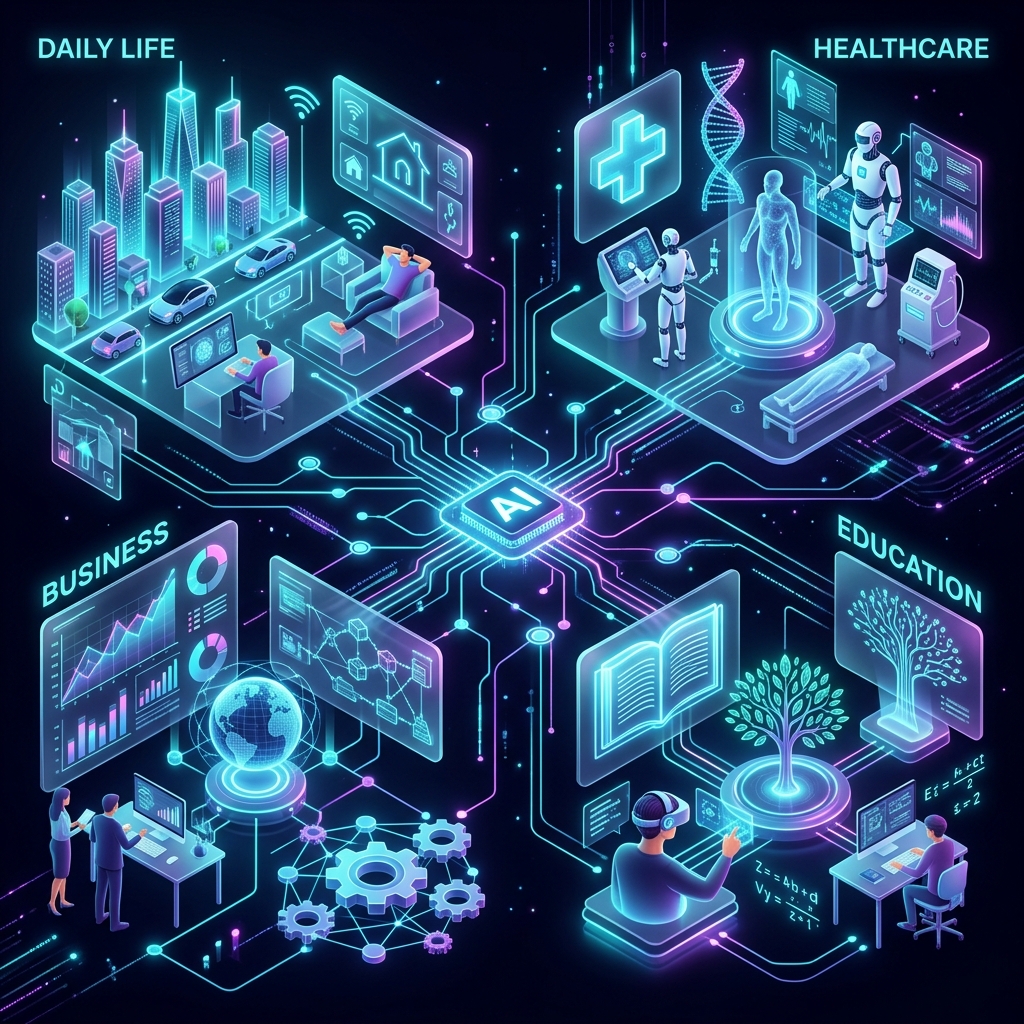
🌍 Introduction: The Era of Intelligent Transformation
Artificial Intelligence (AI) has evolved from a futuristic concept into a practical, everyday necessity. In 2026, AI is no longer limited to tech companies—it is embedded in our smartphones, workplaces, hospitals, and classrooms.
From automating routine tasks to enabling smarter decision-making, AI is fundamentally reshaping how we live and work. This article explores the impact of AI on daily life, corporate environments, healthcare, education, and highlights the top AI tools and emerging AI agents in 2026.
🏠 AI in Daily Life: Making Everyday Tasks Smarter
AI has seamlessly integrated into our daily routines, improving convenience and efficiency.
🔹 Smart Assistants and Automation
AI-powered assistants help users manage schedules, set reminders, and control smart devices through voice commands.
🔹 Personalized Recommendations
Streaming platforms and e-commerce sites use AI algorithms to:
- Suggest relevant content
- Recommend products
- Enhance user experience
🔹 Navigation and Transportation
AI enables:
- Real-time traffic predictions
- Optimized route planning
- Intelligent ride-sharing systems
🔹 Smart Shopping Experiences
Online platforms leverage AI for:
- Product recommendations
- Customer support via chatbots
- Fraud detection systems
🏢 AI in Corporate Life: Driving Business Innovation
AI is transforming how businesses operate, making them more efficient and data-driven.
🔹 Automation of Business Processes
Repetitive tasks like data entry, reporting, and scheduling are now automated, allowing employees to focus on strategic work.
🔹 Data-Driven Decision Making
AI analyzes large datasets to:
- Predict market trends
- Improve forecasting accuracy
- Reduce operational risks
🔹 Enhanced Customer Experience
AI-powered chatbots and virtual assistants provide:
- 24/7 customer support
- Instant responses
- Personalized interactions
🔹 AI in Human Resources
HR departments use AI for:
- Resume screening
- Talent acquisition
- Employee performance analysis
🏥 AI in Healthcare: Revolutionizing Patient Care
AI is playing a crucial role in transforming the healthcare industry.
🔹 Early Disease Detection
AI systems analyze medical data and imaging to detect diseases such as cancer at early stages.
🔹 Personalized Treatment Plans
AI helps doctors design customized treatments based on patient history and data.
🔹 Virtual Health Assistants
AI applications assist patients by:
- Providing medical guidance
- Sending medication reminders
- Monitoring health conditions
🔹 Accelerated Drug Discovery
AI significantly reduces the time required to research and develop new medicines.
🎓 AI in Education: Enabling Smart Learning
AI is reshaping education by making learning more personalized and accessible.
🔹 Personalized Learning Systems
AI adapts educational content based on individual student performance and pace.
🔹 Intelligent Tutoring Systems
Students receive:
- Instant feedback
- Step-by-step explanations
- Customized learning paths
🔹 Automation for Educators
Teachers benefit from AI through:
- Automated grading
- Administrative support
- Performance tracking
🔹 Accessibility and Inclusion
AI tools support differently-abled students through:
- Speech-to-text conversion
- Text-to-speech systems
🌐 AI in Other Industries
AI is also making a significant impact across multiple sectors:
🔹 Finance
- Fraud detection
- Risk analysis
- Algorithmic trading
🔹 Agriculture
- Smart irrigation
- Crop monitoring
- Weather prediction
🔹 Cybersecurity
- Threat detection
- Automated response systems
🔹 Entertainment
- AI-generated content
- Advanced gaming intelligence
🧠 Top AI Tools in 2026
Here are some of the most widely used AI tools across industries:
✨ Content & Productivity Tools
- ChatGPT – Content creation and coding
- Notion AI – Smart documentation
- Grammarly AI – Writing assistance
🎨 Creative & Design Tools
- MidJourney – AI image generation
- DALL·E – Visual content creation
- Runway ML – AI video editing
💻 Development Tools
- GitHub Copilot – Code generation
- Cursor AI – AI-powered coding assistant
📊 Business Intelligence Tools
- Tableau AI – Data visualization
- Power BI AI – Business analytics
🤖 AI Agents in 2026: The Rise of Autonomous Systems
AI agents represent the next phase of AI evolution.
🔹 What Are AI Agents?
AI agents are intelligent systems capable of:
- Performing tasks autonomously
- Making decisions
- Learning from interactions
🔹 Examples of AI Agents
- Autonomous task execution systems
- AI-powered customer support bots
- Personal digital assistants managing workflows
🔹 Real-World Applications
- Automating entire business operations
- Managing emails, schedules, and projects
- Conducting research and analysis
⚠️ Challenges and Ethical Concerns of AI
Despite its benefits, AI presents several challenges:
- Job displacement due to automation
- Data privacy and security concerns
- Bias in AI algorithms
- Over-reliance on technology
Solution: Ethical AI development and proper regulations are essential.
🔮 Future of Artificial Intelligence
The future of AI is both promising and transformative:
- Increased human-AI collaboration
- Growth of autonomous AI agents
- Expansion across all industries
- Smarter and more adaptive systems
AI will not replace humans—but individuals and organizations that effectively use AI will gain a significant advantage.
✅ Conclusion: Embracing the AI-Driven Future
Artificial Intelligence in 2026 is redefining how we live, work, and innovate. From enhancing daily convenience to revolutionizing industries like healthcare, education, and business, AI is a powerful driver of progress.
To stay competitive in this evolving landscape, it is essential to understand AI, adapt to its changes, and leverage its capabilities.